Service Design & Experience Research
I’m a service designer, UX researcher, and experience strategist with a background that spans behavioral health, nonprofits, city government, federal agencies, education, housing, and technology. I’ve worked with organizations including the City of Austin, U.S. Department of State, U.S. Air Force, Google, Macmillan Learning, and Rocket Central—often on complex services where people are navigating uncertainty, high stakes, or systems that were never designed around how they actually live.
My approach combines human-centered research, systems thinking, service design, and a foundation in psychology and direct human services. I look beyond the interface to understand the policies, workflows, handoffs, incentives, and relationships shaping an experience—then help teams turn that complexity into services that are clearer, more useful, more equitable, and easier to navigate.
At the center of my work is a simple belief:
To design for someone is to retain power. To design with someone is to share it.
My work has moved across public service, technology, education, housing, and human services—but the throughline has remained consistent: understand the system, center the people navigating it, and make the experience clearer, more humane, and more effective.
Experience Strategist · Fearless Digital · 2024–2026
Led service design, UX research, content strategy, and modernization initiatives supporting the Bureau of Consular Affairs Customer Experience Team. My role connected the public-facing experience on Travel.State.Gov with the operational systems, policies, workflows, and frontline realities behind it—particularly for people seeking critical guidance during stressful, uncertain, or time-sensitive situations.
Across multiple workstreams, I helped restructure prevention content and information architecture, develop trauma-informed usability research frameworks, connect UX recommendations with analytics and measurement strategies, and translate frontline staff feedback into leadership-ready modernization insights.
A global modernization survey generated 135 responses from 57 missions across 50 countries, helping surface recurring system-level opportunities related to service delivery, staff capacity, tools, workflows, communication, and operational friction. The findings were synthesized into strategic frameworks and visual narratives designed to support leadership decision-making and future modernization efforts.
Product & Service Strategist · 2022–2024
Led discovery, research strategy, service definition, and product planning across complex federal innovation and STEM initiatives. My role often involved turning loosely defined ideas into understandable service models—mapping stakeholders, identifying user and organizational needs, facilitating cross-functional workshops, creating service blueprints and journeys, prototyping concepts, and developing phased implementation strategies that accounted for governance, security, funding, and operational constraints.
AFRL / Space Force Innovator Sandbox
Designed the service model for an innovation ecosystem connecting government innovators with researchers, technical experts, academic partners, commercialization resources, and external expertise. I conducted stakeholder discovery, facilitated design workshops, mapped the end-to-end innovator experience, and developed service blueprints covering onboarding, mentoring, rapid prototyping, validation, funding pathways, security, intellectual property, and commercialization.
The work moved the Sandbox from an emerging concept toward a coordinated service model with clearer roles, handoffs, governance needs, and pathways for moving ideas from early exploration toward validation and implementation.
AFRL STEM Portal MVP
Helped define and design an MVP digital experience connecting AFRL STEM opportunities with students, educators, faculty, and program administrators. The engagement included stakeholder research, experience and content modeling, information architecture, prototype development, and definition of the MVP implementation approach.
The project moved from research and design into development, creating a clearer foundation for organizing STEM programs, opportunities, and resources within a scalable digital platform.
U.S. Department of Veterans Affairs — Veterans Experience Team
Translated existing Veteran Journey Maps into a phased dashboard and decision-support concept that connected Veterans' lived experiences and “moments that matter” with service-delivery and organizational data.
The work explored how journey research could move beyond a static artifact and become an operational tool—supporting prototype validation, data integration, feedback loops, measurement, and ultimately better organizational decisions about the experiences Veterans encounter across VA services.
New Mexico Tech Sector Enhancement Initiative
Conducted ecosystem research examining New Mexico's technology and innovation landscape through stakeholder research, mapping, synthesis, and a 641-response ecosystem survey. The work identified relationships, barriers, opportunities, workforce needs, and areas where stronger coordination could support the state's technology sector.
Findings were translated into strategic and policy-oriented recommendations and contributed to broader statewide planning, including work informing the New Mexico 2027 Five-Year Strategic Plan.
Senior Experience Designer · 2021–2022
Led research and service design across the interconnected Rocket Central, Rocket Mortgage, and Rocket Homes ecosystem, with particular attention to the experience of first-time, minority, and lower-income homebuyers across four cities.
I reframed the experience as an end-to-end homeownership journey rather than a sequence of individual products—examining home search, affordability, financial readiness, education, trust, application, and handoffs between brands. Through research, journey mapping, workshops, and cross-functional collaboration, I helped teams identify where disconnected products and organizational boundaries were creating friction and develop a more integrated customer experience.
Freelance Civic UX / Service Design · 2021

Supported Leadership Austin and Austin Tech Alliance in shaping the information architecture and user experience for Informed Vote, a civic-engagement initiative designed to make nonpartisan voting information easier to find, understand, and use.
The work included site structure, user flows, wireframes, and experience concepts focused on helping people move from questions about an election or issue toward understandable, actionable information without requiring them to understand the organizational structure behind the content.
Service Design Consultant · 2020–2021
Researched and mapped Google's Law Enforcement Request System (LERS), a secure service supporting interactions between Google and verified law-enforcement and government requestors.
I examined the end-to-end request experience across users, products, legal processes, internal teams, and supporting systems—combining qualitative research, workflow analysis, request-pattern data, journey mapping, and service blueprinting to identify fragmented processes and points of uncertainty.
The work helped create a more unified picture of the service and informed concepts for clearer request submission, status visibility, cross-product coordination, and internal handoffs while operating within significant privacy, security, legal, and policy constraints.
Lead Service Designer / UX Researcher · 2017–2020
Led human-centered research and service redesign across some of the City of Austin's most complex resident-facing systems. Projects spanned public health, homelessness, police oversight, permitting, community gardens, food trucks, fall-prevention services, and civic access.
I worked directly with residents, frontline employees, department leadership, technologists, and policy stakeholders to understand how services actually operated—not simply how procedures said they operated. Research was translated into journey maps, service blueprints, prototypes, future-state workflows, implementation plans, and policy or operational recommendations.
Projects included redesigning the Austin Police Department complaint experience with the Office of Police Monitor, improving permitting processes, supporting homeless-service initiatives, and creating clearer digital pathways for residents navigating City programs.
Projects
Austin Police Department Complaint Process Redesign
With the Office of Police Monitor / police oversight teams; focused on accessibility, procedural clarity, trust, and the resident complaint experience.
Pool Permitting Modernization
Austin Public Health / Environmental Health Services; mapped the permitting journey, identified process friction, and developed future-state workflows and prototype concepts.
Community Garden Permitting Improvements
Parks & Recreation; streamlined a complicated permitting process and improved clarity for community garden applicants.
Mobile Food Vendor / Food Truck Permitting
Austin Public Health / Environmental Health Services; examined permitting, inspections, information needs, and opportunities to make the service easier to navigate.
Parking Permitting Simplification
Austin Transportation Department; service-design work focused on simplifying resident-facing parking permit processes.
Purple Bag / Violet Bag Garbage Collection Pilot
Homeless-services initiative focused on supporting people living in encampments while improving access to waste-removal services.
Navigation Center / Drop-In Service Center Pilot
Six-week service pilot involving Austin Public Health, Downtown Austin Community Court, service providers, and other partners; examined coordinated access to services for people experiencing homelessness.
Homeless Lived Experience Mapping
Research and service mapping focused on understanding the lived experience of homelessness and translating that experience into implementation and service-planning opportunities.
Encampment Management / Encampment Work
Cross-department work involving Public Works, ODD, APD, Parks & Recreation, Integral Care PATH, and other partners to understand and improve how the City coordinated services around encampments.
Living Resource List
Work supporting clearer access to and maintenance of homelessness-service information and community resources.
Austin Homeless Advisory Committee
Work incorporating lived experience and community voice into homelessness-service planning and decision-making.
Senior Home Safety / Fall Prevention Program
Emergency services / Austin Fire-related work focused on outreach and service design for older adults at risk of falls and injury.
Restore Rundberg Community & Service Provider Workshop
Facilitated a service-design workshop with approximately 23 community service providers, mapping needs, relationships, and opportunities across the Rundberg service ecosystem.
Downtown Austin Community Court — Service Planning
Research and service-design work examining intake, service journeys, partner workflows, case-assistance processes, and measures of success.
Austin Mobile Court
Work focused on bringing court and support services to people who could not easily access traditional court settings; included service journeys, intake, partnership workflows, and measurement.
UX Research / Service Design · 2017
Helped establish a combined user-centered design and learning-science research environment supporting product teams developing educational experiences for students and instructors.
My work included designing research processes and lab operations, participant recruitment practices, screeners, moderated and unmoderated usability studies, surveys, interviews, ethnographic research, and synthesis. I also helped build the infrastructure that allowed product, design, and learning-science teams to observe research and use evidence more consistently throughout product development.
UX Research / Service Design · 2017
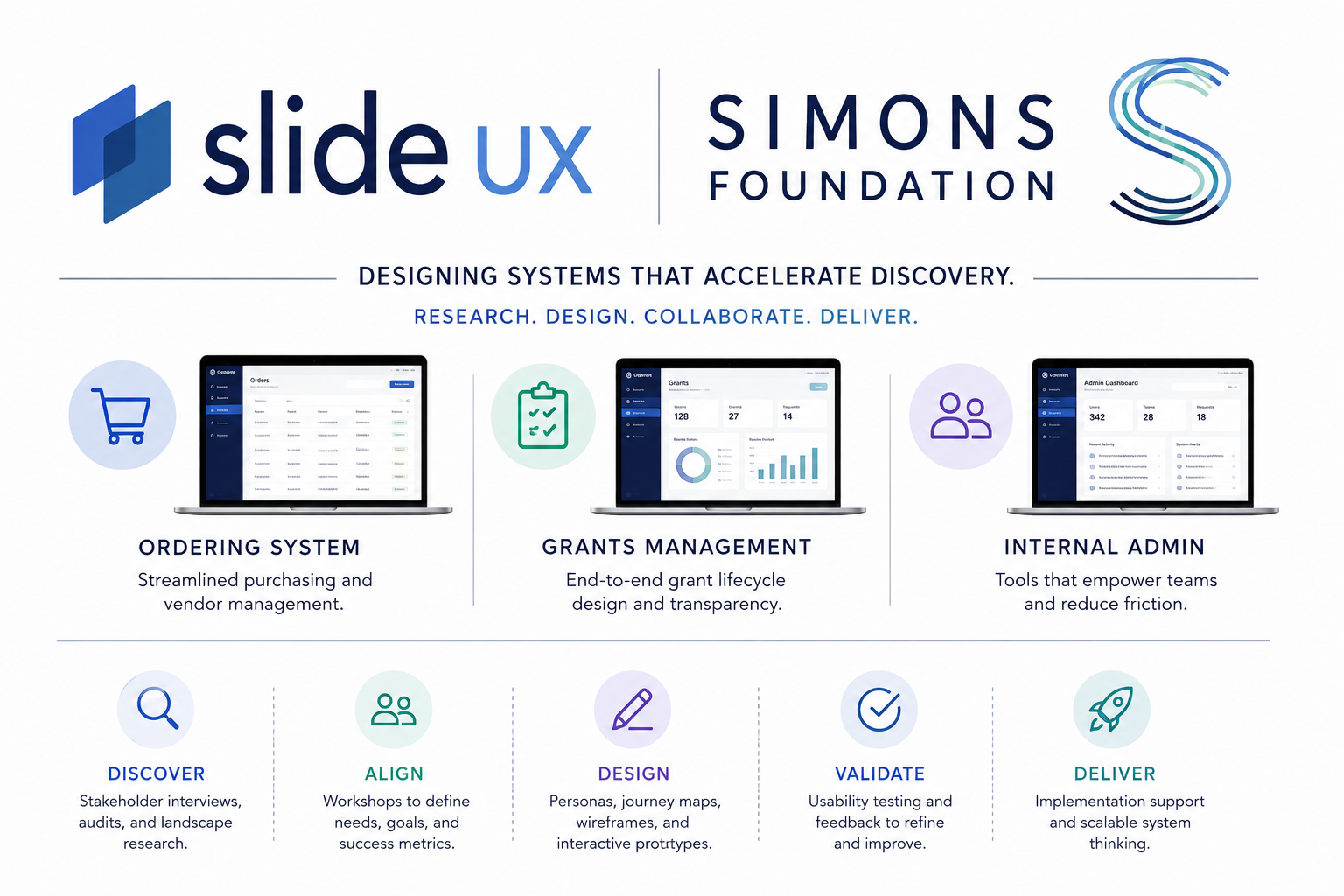
Supported discovery and UX research for the consolidation and redesign of the Simons Foundation’s Grants Management, Ordering, and Internal Administration systems. Conducted stakeholder and user interviews, onsite focus groups, heuristic reviews, journey mapping, user-story analysis, and workshops to identify workflow friction and shape a more integrated, user-centered enterprise experience.
UX Research & Design · 2016
Supported research and experience design for education-focused digital services used by educators and administrators. I helped translate complex program requirements and user needs into clearer workflows, information structures, interaction concepts, and prototypes.
The work strengthened my early practice in applying human-centered design within institutional environments where the interface is only one part of a much larger service involving people, processes, rules, and organizational responsibilities.
Freelance UX Research & Service Design · 2016
Conducted community-centered research with OutYouth, exploring how LGBTQ+ young people, staff, supporters, and donors interacted with the organization's services and digital presence.
Research examined issues including privacy, safety, connection, crisis support, access to resources, and differing audience needs. I translated findings into audience models, journey maps, content and experience concepts, wireframes, and ideas for creating a more secure and supportive digital connection between young people and the organization.
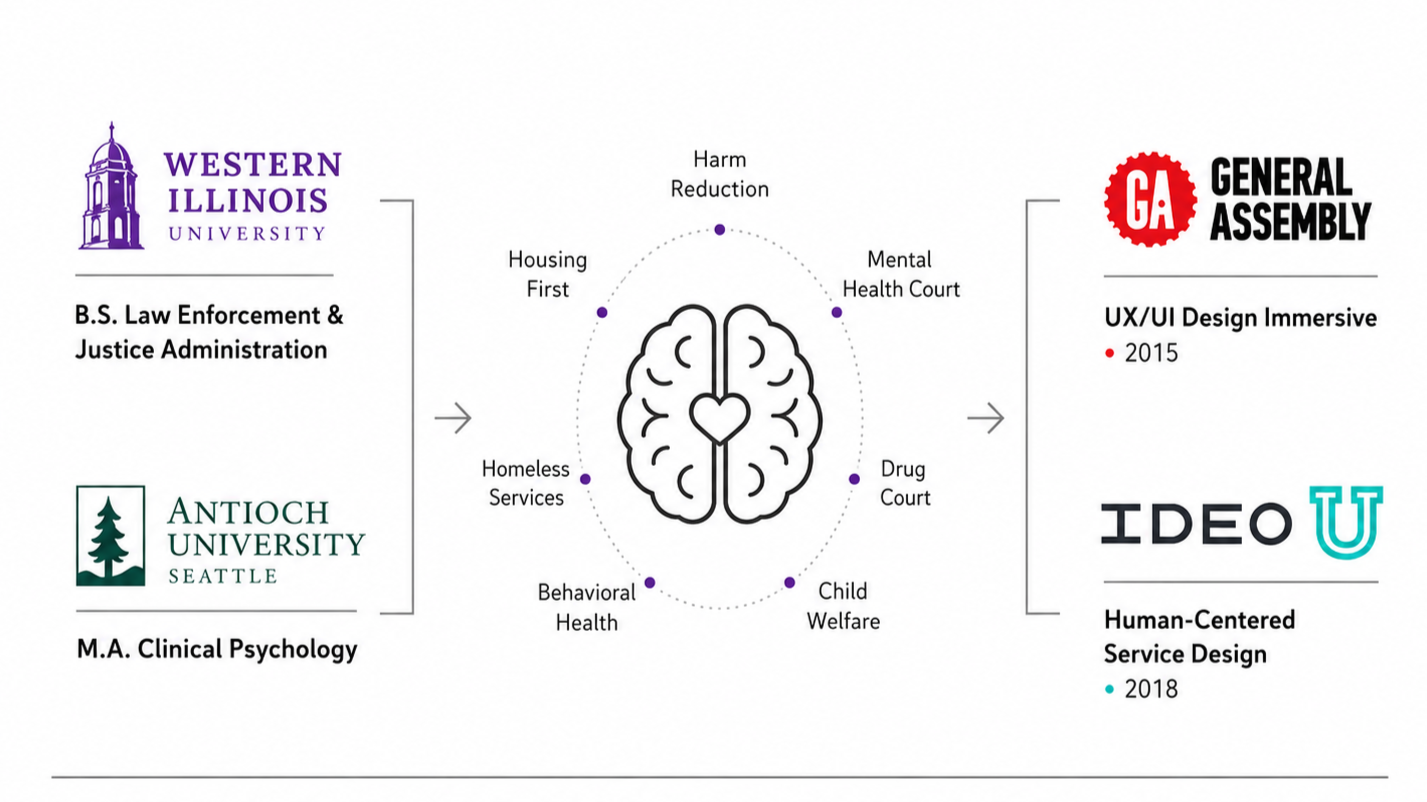
IDEO U - Human-Centered Service Design 2018
General Assembly - UX/UI Design Immersive 2015
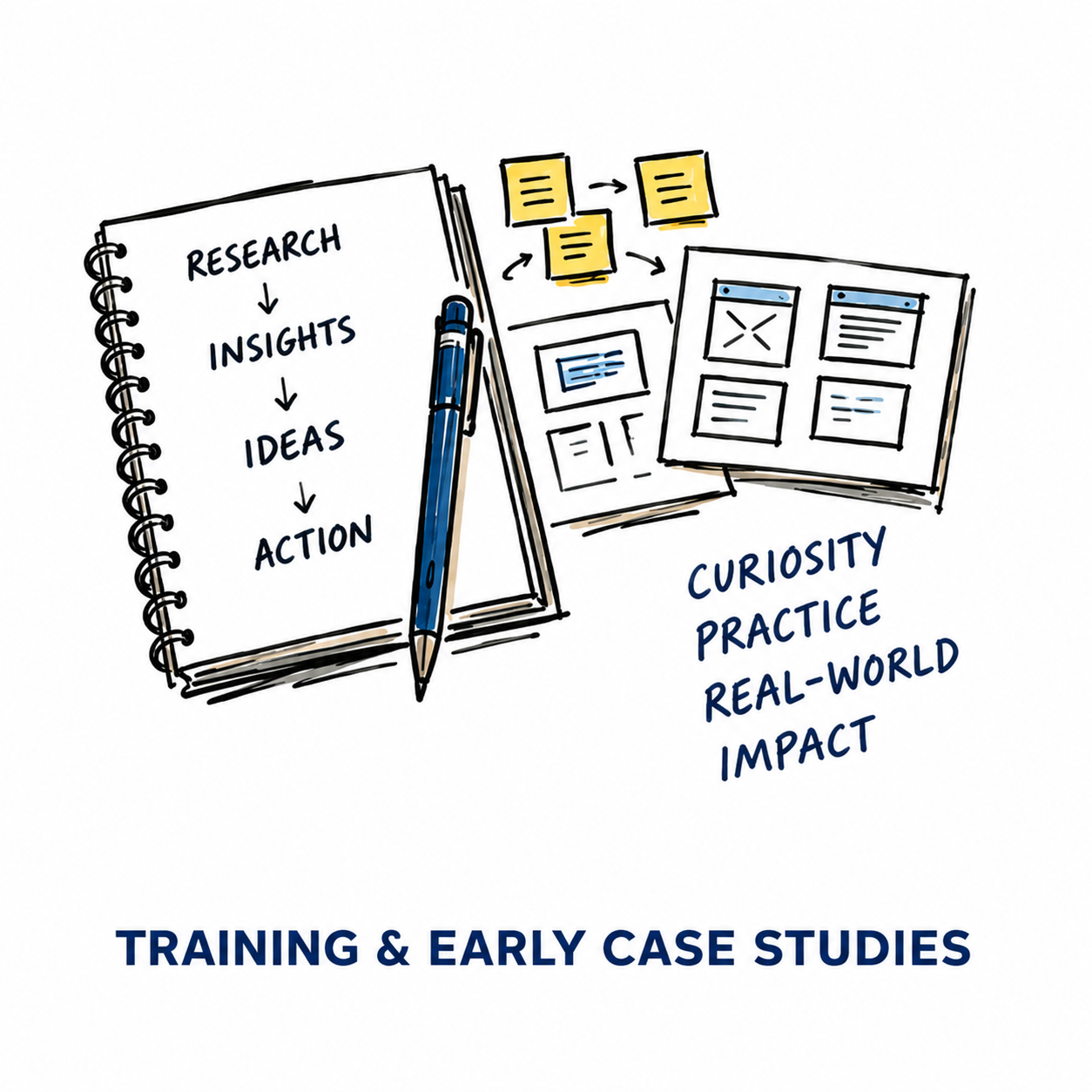
Completed formal design training through General Assembly’s UX/UI Design Immersive and later expanded that foundation through IDEO U’s Human-Centered Service Design program.
Together, the programs strengthened my practice across user research, information architecture, interaction design, prototyping, usability testing, visual communication, service design, co-creation, and iterative problem solving. They helped translate more than a decade of experience in psychology, behavioral health, and complex human-service systems into a structured human-centered design practice.
The early case studies linked here document that transition—from working directly inside complex services to researching, mapping, prototyping, and redesigning the systems themselves.
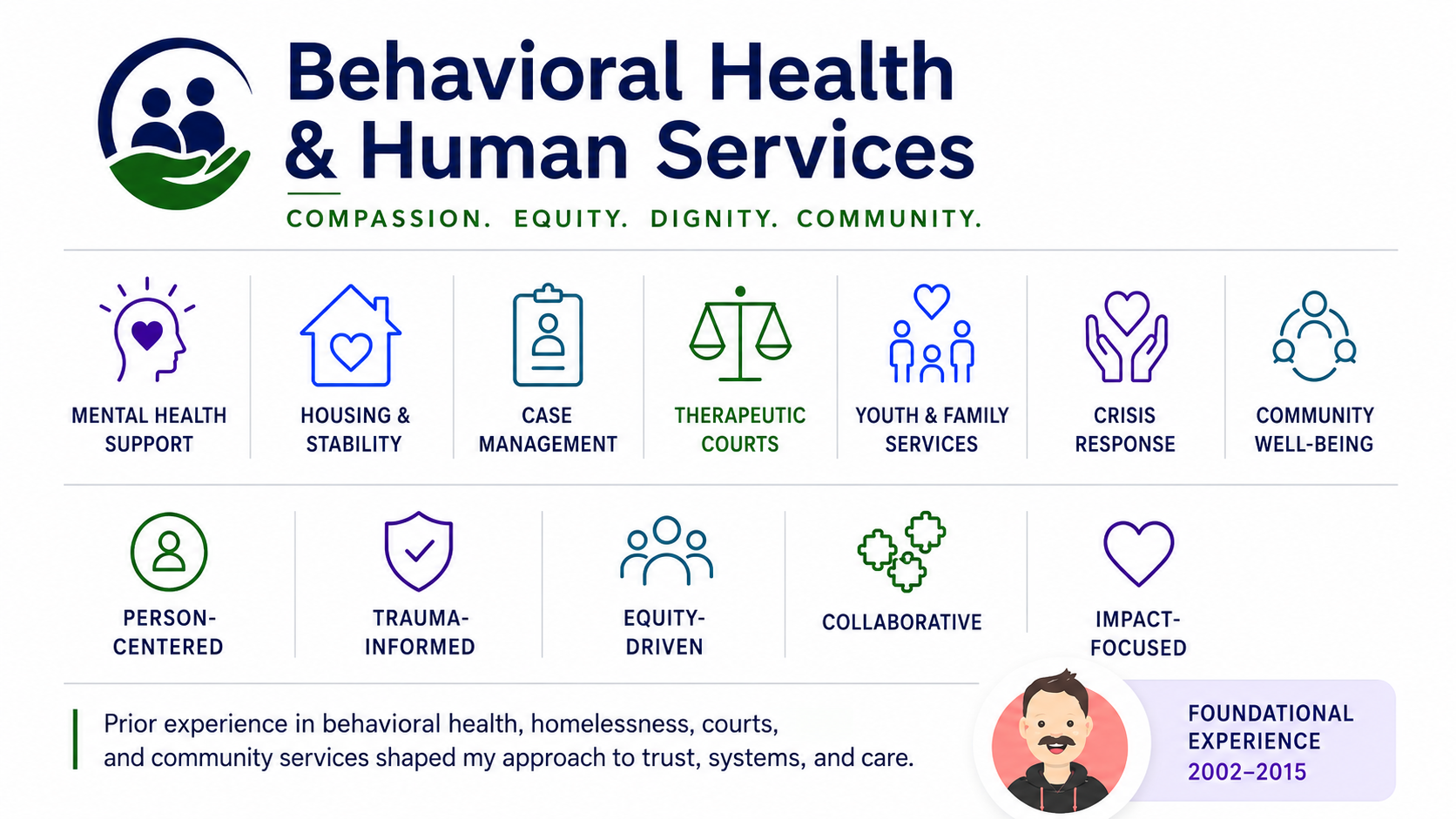
Prior Experience · 2002–2015
Before moving into design, I spent more than a decade working across mental health, homelessness, substance use, therapeutic courts, child welfare, and public behavioral-health systems. My roles included clinical therapy, homeless outreach, case management, crisis intervention, court-based services, behavioral support, and cross-agency care coordination.
That work also gave me early experience with research, evidence-based practice, systems thinking, and service improvement. At DESC’s 1811 Eastlake Housing First program, I worked alongside University of Washington researchers evaluating outcomes for formerly homeless adults with chronic alcohol-use disorders—work that contributed to a broader body of published research on housing, service utilization, quality of life, alcohol use, and motivation for change.
These experiences became the foundation of how I approach design today: understanding trust, power, trauma, motivation, policy, handoffs, and what happens when people must navigate complex systems while already under stress.
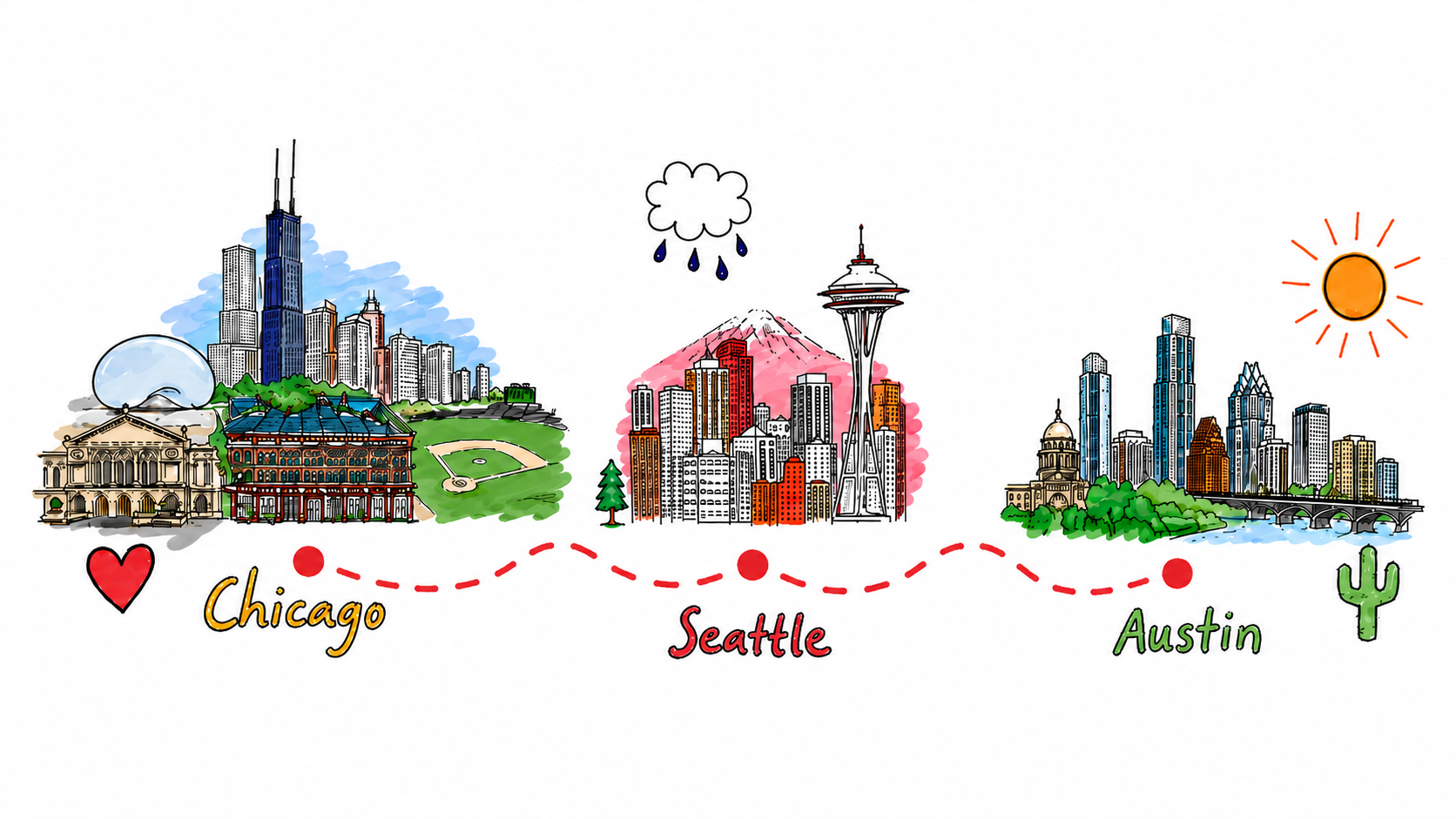
I was born and raised in Chicago. After earning my Bachelor's degree, I moved to Seattle, drawn by its rain, coffee culture, and penchant for flannel layering. During my time there, I pursued a Masters in Clinical Psychology, becoming a trained mental health professional. This experience provided me with valuable opportunities to work with diverse populations, addressing a wide range of challenges and crafting solutions grounded in strengths.
Throughout my journey, I received comprehensive training in individual, group, and family counseling, practicing various therapeutic approaches and interview methods. These included cognitive-behavioral and humanistic therapies for personal growth, art therapies for emotional expression, and family systems theory for addressing group dynamics and systemic issues. In my direct service roles, I recognized the crucial role of solid data in advocating for and supporting individuals during critical service moments. This understanding was pivotal during my involvement in evaluating the 1811 Eastlake supportive housing program in collaboration with the University of Washington. Our findings, published in respected journals, underscored the program's effectiveness in reducing alcohol-related issues and enhancing residents' quality of life. Read More
Upon relocating to Austin, I focused on integrating design principles into social work environments. During this period, I expanded my knowledge by completing a UX certificate from General Assembly and participating in the IDEO Human-Centered Service Design course. This transition led to roles at Macmillan Learning, Google, and the City of Austin's Service Design Lab, where I contributed to projects aimed at optimizing educational and city services to better meet user needs and enhance usability. These experiences enabled me to bridge the gap between social work practices and innovative design solutions, reinforcing my commitment to creating meaningful experiences and improving service delivery for all communities.
Designing within the civic sector presented its own unique challenges, including navigating governmental protocols, compliance standards, and security requirements. My demonstrated adeptness in understanding and adapting to the regulatory landscape ensured that our solutions not only met user needs but also complied with all necessary regulations. My ability to navigate these complexities while maintaining a focus on user experience underscores my exceptional skill and dedication to delivering high-quality design solutions in any environment. I also consistently served as a mediator between stakeholder needs, ensuring alignment throughout the project lifecycle.
In parallel to my service design roles, I co-founded Periphery Design Co-op in Austin. Our team specializes in community-focused service design, employing a user-centered approach in digital and physical projects. We prioritize solutions that address root problems, offering facilitation, tools, workshops, and support to empower individuals and communities to create tailored solutions, with deep consideration of history, culture, and environment.
Throughout my career spanning Chicago, Seattle, and Austin, I have remained committed to leveraging my background in clinical psychology and social work to drive innovation in service design. Looking forward, I'm passionate about leveraging AI and machine learning to create more personalized and efficient solutions that meet the evolving needs of communities. My journey is driven by a passion for enhancing tools and systems for direct service professionals, with the ultimate goal of creating meaningful experiences and improving service delivery across all communities.
Austin Design Week, 2019
A panel discussion on conducting design research while consciously navigating sensitive topics and the impact research has on designing for multidimensional problems at scale.
Better World by Design, 2019
Brown University invited us to conduct a workshop on Human Centered Research Methods. Participants were provided case studies with real life examples from the University’s HOPE student organization. Participants left with a better understanding of the challenges faced by service providers, and an in-depth service design toolkit to assist service providers with work based trauma. Toolkit
Civic Futures Summit, 2019
Community-Driven Design for Better Technology, Programs & Policies, was a two day workshop introducing the techniques of civic service design with examples of successful city project case studies from New York’s Service Design Studio, and Austin’s Service Design Lab.
Austin Design Week, 2018
Like many communities around the country, and the world, Austin is currently grappling with questions about how to serve a growing population of people experiencing homelessness. This panel was set up to discuss design methods and strategies used when working within a system assisting participants experiencing homelessness.